Continuing a recent theme of the evocative nature of scent, this website, I Hate Perfume, contains some intriguingly-named perfumes, the descriptions of which, while they often skate perilously close to laughable, are more interesting than, for instance, the revolting cheap knock-offs on sale in a chemist's shop near my flat in Byres Road, Glasgow, in the early 1990s: if you liked Christian Dior's POISON (a late 1980s, overpoweringly strong and cloyingly sweet scent which was unpleasant enough in itself), you could buy the charmingly titled KILL ME in a nasty purple bottle just differentiated enough to avoid a lawsuit; instead of Calvin Klein's OBSESSION, you could buy a classy amber coffret containing COMPULSION.
Christopher Brosius ("CB"), the "olfactory artist" behind I Hate Perfume, can create custom perfumes, but is currently not taking orders, so I'm afraid Childhood tantrum ends in woodshed is out for the moment; but I think Gathering apples may be an acceptable substitute. It's described as "Thousands of ripe red Mackintosh apples and a bit of old weathered wood from the bushel baskets".
Saturday, January 31, 2009


Saturday, January 24, 2009
Such great heights
I was searching for some wonderful shoes to justify the title of this email and nearly drew a blank: designers once again seem to have gone slightly bonkers. What happened to what Karl lagerfeld described as "the new modesty" in light of the global economic downturn? (In the same article he also said that he "throws money out of the window and it comes back in the door", and that "for me the bottom line is that there is no bottom line". Let's hope economic reality hits him between the eyes with all due dispatch.) Even normally sensible, even predictable designers like Louboutin have gone all Britney Spears.

Starting gently with some shoes from Gina: usually too frou-frou for me, but I wouldn't be ashamed to wear these: although I am still unsure about the deplorable über-wedge, compared to the first-year art projects masquerading as something wearable, viz. exhibits A, B and C below (which are tiny so I don't desecrate my blog too much) they are downright beautiful.
And then: the Deranged Collection, from Louboutin. Deliberately shrunken photographs so as to avoid offending the senses.

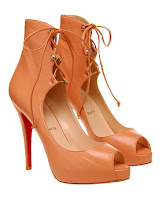

The problem with making red soles his trademark is that he'll never be able to deny that these monstrosities were his idea.

Starting gently with some shoes from Gina: usually too frou-frou for me, but I wouldn't be ashamed to wear these: although I am still unsure about the deplorable über-wedge, compared to the first-year art projects masquerading as something wearable, viz. exhibits A, B and C below (which are tiny so I don't desecrate my blog too much) they are downright beautiful.
And then: the Deranged Collection, from Louboutin. Deliberately shrunken photographs so as to avoid offending the senses.


The problem with making red soles his trademark is that he'll never be able to deny that these monstrosities were his idea.
Thursday, January 22, 2009
Hard core
Apple Martini
2 oz. vodka
1½ oz. Bols sour apple liqueur
½ oz. Lemon juice
Apple slice for garnish
Shake well with ice and strain into a chilled martini glass. Garnish with a slice of apple, serve, and drink in huge quantities.

Freshly served apple martini at the CitySpace bar, 70th floor, Swissotel the Stamford, Singapore, January 21, 2009.
Wednesday, January 21, 2009
Where there is darkness, light
Just before beginning his medical studies at Oxford, M suffered terrible brain injuries in a motorbike accident, from which he would never recover. He ended up, a few years later, living in the caravan behind our cottage and working on woodcarving in my dad’s workshop. Although I remember some massive lumpen figures, his passion and his nemesis was his Welsh love spoons, which he would spend hours carving: a single lump of wood produces two spoons, which are interlinked by a loop at the end, so the wood must remain unbroken, and time after time, as he painstakingly whittled away, the spoons would break at the weakest point and he would have to begin again.
M loved Bob Dylan and used to sit in his favourite patchwork chair in our living room, right by the blazing fire, reeking pipe in hand, listening to Stuck Inside of Mobile (With the Memphis Blues Again) and Don’t Think Twice, It’s All Right , tapping his feet and gazing into the distance. He was a very tall man, with a large head, always crowned with a black beret, and a big beard; a gentle, dazed character, unable to retain memories of either the recent or the distant past. Of course we children were slightly frightened of him but also found him amusing, in our cruel and careless way; fond of a drink, he used to walk down to the local pub, the Winton Arms, and stumble back up the road completely trashed, swaying and smiling, as we followed mockingly in his wake. I know we used to upset and anger him sometimes.
From this distance M’s story is unutterably sad; I remember him coming home from the pub once and crying helplessly, repeating the words of Bonnie Tyler’s Total Eclipse of the Heart: “Once upon a time I was falling in love/Now I’m only falling apart…”, because it had been playing on the jukebox and something in the words suddenly hit him very hard. He sometimes seemed to be very aware of what he had lost in his accident; at other times there was a kind of happy innocence about him. He was almost sucked in, as a lot of my parents’ friends were, by the cult of Bhagwan Shree Rajneesh, but he came back from Poona, where Bagwhan had his ashram at the time, saying he “refused to be Bagwhashed”. He was half in love with my sister and wrote letters to her. He had a harrowing appearance at Haddington Sheriff Court: someone had been stealing money from the till at the pub and they set a trap which caught M, guilelessly leaning over the bar to take the cash while the barman’s back was turned.
M had The Mass of St Francis of Assisi (“where there is…let me bring”, forever besmirched by being presumptuously arrogated by Thatcher on her election day) and this quote pinned up in his caravan:
“The mark of your ignorance is the depth of your belief in injustice and tragedy. What the caterpillar calls the end of the world, the Master calls a butterfly”. (Richard Bach)
M now lives in Wales with his brother. He’s old and very frail and recently had a leg amputated because he had diabetes. My brother, who went through some troubles of his own, spent some time with him recently and said he seemed happy. I like to think of him still carving love spoons, though I doubt he does it any more, and listening to his favourite Dylan line: "Your debutante just knows what you need, but I know what you want".
Monday, January 19, 2009
Slouching towards Louis Vuitton
The most loathsome of dictator's wives, Grace Mugabe (who has to wear Salvatore Ferragamo shoes because her feet are too narrow for anything cheap), was in Hong Kong last week, shopping for luxury goods, and managed to get herself involved in a fracas with a photographer in Tsim Sha Tsui (naturally, she was staying at the nearby Kowloon Shangri-La), who was trying to get pictures of Grace shopping in the numerous luxury shops in the area. Her diamond rings double as knuckledusters and the South China had pictures of the poor man's face streaked with blood.
Apparently Grace and her villainous husband withdrew $92,000 from Zimbabwe's bank reserves to fund their holiday. Meanwhile, Zimbabwe is suffering from a cholera epidemic that has killed 2,200 people and an economic meltdown that has driven the rate of inflation to 231 million per cent.
Apparently Grace and her villainous husband withdrew $92,000 from Zimbabwe's bank reserves to fund their holiday. Meanwhile, Zimbabwe is suffering from a cholera epidemic that has killed 2,200 people and an economic meltdown that has driven the rate of inflation to 231 million per cent.
Chrysalis
We found it on a bunch of grapes and put it
In cotton wool, in a matchbox partly open,
In a room in London in wintertime, and in
A safe place, and then forgot it.
Early in the cold spring we said "See this!
Where on earth did the butterfly come from?"
It looked so unnatural whisking about the curtain:
Then we remembered the chrysalis.
There was the broken shell with what was once
The head askew; and what was once the worm
Was away out of the window, out of the warm,
Out of the scene of the small violence.
Not strange, that the pretty creature formalized
The virtue of its dark unconscious wait
For pincers of light to come and pick it out.
But it was a bad business, our being surprised.
Muriel Spark, 1918-2004
Saturday, January 17, 2009
Stirred
Lychee martini
3 ounces of premium vodka
1 ounce of lychee liqueur
1 lychee, peeled and pitted
ice
Shake together the vodka, liqueur and ice and strain into a chilled martini glass. Garnish with the peeled lychee and serve.

Recipe from the admirable Lychees Online; side elevation of freshly delivered martini, Aqua, Hong Kong, Friday January 16, 2009.
Sunday, January 11, 2009
Something in the woodshed
As a child, whenever I was upset about something I would "run away" and hide in the woodshed behind our cottage. The wood was delivered from the local sawmill in roughly hewn, chunky logs which were fragrant, slightly damp, and still covered in bark and moss; I had to climb up over a huge pile to get to my favourite spot, right at the back, where I would make myself a little nest amongst the logs and sit sobbing until I felt better, with my only friends the little spiders and beasties who were attracted to my torch (which I always had the presence of mind to bring). It could be cosy and surprisingly warm; if it was windy and I could hear the rain hitting the corrugated roof, it was a satisfyingly melodramatic gesture yet very comforting. I always felt better when I emerged (usually to find that no one had even noticed I was gone).
The woodshed has moved location now but for old times' sake, when I was home at Christmas I tried climbing in to the back, over the piles of logs. The cold and the smell were incredibly evocative. It might only sell to the likes of me but it occurred to me that someone should bottle it.
The woodshed has moved location now but for old times' sake, when I was home at Christmas I tried climbing in to the back, over the piles of logs. The cold and the smell were incredibly evocative. It might only sell to the likes of me but it occurred to me that someone should bottle it.
Saturday, January 03, 2009
Strange Meeting
It seemed that out of battle I escaped
Down some profound dull tunnel, long since scooped
Through granites which titanic wars had groined.
Yet also there encumbered sleepers groaned,
Too fast in thought or death to be bestirred.
Then, as I probed them, one sprang up, and stared
With piteous recognition in fixed eyes,
Lifting distressful hands, as if to bless.
And by his smile, I knew that sullen hall, -
By his dead smile I knew we stood in Hell.
With a thousand pains that vision's face was grained;
Yet no blood reached there from the upper ground,
And no guns thumped, or down the flues made moan.
'Strange friend,' I said, 'here is no cause to mourn.'
'None,' said that other, 'save the undone years,
The hopelessness. Whatever hope is yours,
Was my life also; I went hunting wild
After the wildest beauty in the world,
Which lies not calm in eyes, or braided hair,
But mocks the steady running of the hour,
And if it grieves, grieves richlier than here.
For by my glee might many men have laughed,
And of my weeping something had been left,
Which must die now. I mean the truth untold,
The pity of war, the pity war distilled.
Now men will go content with what we spoiled,
Or, discontent, boil bloody, and be spilled.
They will be swift with swiftness of the tigress.
None will break ranks, though nations trek from progress.
Courage was mine, and I had mystery,
Wisdom was mine, and I had mastery:
To miss the march of this retreating world
Into vain citadels that are not walled.
Then, when much blood had clogged their chariot-wheels,
I would go up and wash them from sweet wells,
Even with truths that lie too deep for taint.
I would have poured my spirit without stint
But not through wounds; not on the cess of war.
Foreheads of men have bled where no wounds were.
I am the enemy you killed, my friend.
I knew you in this dark: for so you frowned
Yesterday through me as you jabbed and killed.
I parried; but my hands were loath and cold.
Let us sleep now...'
Wilfred Owen (1893-1918)
Tuesday, December 30, 2008
Oblique midwinter
I grew up in an extraordinarily cold house, where getting dressed under the bedclothes in winter was essential, there was frost on the insides of the window panes, and we used to put the gas oven on with the door open to get a little heat in the kitchen. Probably as a result I am miserable in cold weather and have a powerful addiction to the moment when you step out of the cold into a warm room.
I walked to the end of the road this morning, my last day in London, to pick up the newspaper. It was that kind of bone-chillingly cold day I'd forgotten all about, where your ears and face start to hurt with it just walking along; like any visceral pain it's impossible to remember it properly when you're not experiencing it, and it made me appreciate once again the fact that I live in a climate where it never gets colder than 10 degrees.
Every day there's some sharp reminder of how lucky I am to live in a bubble; today on the front of The Guardian, a picture of a man in Gaza with greyed and bloodied face, reaching for help from the hole he's buried in. The Daily Mail, meanwhile, focuses on something much more important; the headline shrieks about benefit claimants PAID 20,000 NOT TO WORK and you have to wait till page 6 to read anything about Israel.
I hate to sound trite, but this seems to be a time to work out what really matters: the people you love, little things that make life better, being positive even if there's uncertainty ahead. To quote Harold Pinter (1930-2008) out of context: what else is there?
Wednesday, December 24, 2008
A love of nature keeps no factories busy
I went shopping in Edinburgh today amidst huge discount signs; everything is on sale already. Something about the abundance of clothes on the racks gives the shops an almost jumble sale feel, which I must admit fills me with torpor. I particularly resent the implication that consumers are somehow expected to spend our way out of the recession. Why is no one suggesting that it might be no bad thing for us to stop consuming? Before the crisis started to become inexorable Ben Bernanke said that "the main source of imbalance in the global economy was not excess spending at home but, rather, excess saving in China and other developing countries, where consumption was artificially low". This sort of self-deluding myopia is what caused all the trouble; and I am definitely liking neither the idea nor the reality of consumption at the moment. But nonetheless, in the kind of contradictory gesture I'm often guilty of, here are some more ideas for my trenchant critics to get their teeth into:

Alexander McQueen, from Net-a-Porter: sky high heels to make anyone feel good;

Issa, from Matches (something about the casual way they display the clothes is accessible and at the same time a bit downbeat); and

Vivienne Westwood from Net-a-Porter.

Alexander McQueen, from Net-a-Porter: sky high heels to make anyone feel good;

Issa, from Matches (something about the casual way they display the clothes is accessible and at the same time a bit downbeat); and

Vivienne Westwood from Net-a-Porter.
Tuesday, December 23, 2008
Ghosts of Christmas past
After my parents divorced in the 1980s, a new, mostly amicable family tradition emerged, which is that every Boxing Day, the whole extended family (my mum (Marg) and her partner, my dad (Chris) and his wife, plus half-sisters, siblings, aunts, and anyone else who's around) spend Boxing Day together, alternating between Chris's house and Marg's. Particularly in the early years, and also particularly when it was Chris's turn to be host, this was a rather fraught event, for a number of reasons as well as the usual toxic festive mix of everyone being hungry, and having had too much to drink instead, and the usual family fortunes.
Twenty years ago, at Chris's, I had a furious row with Marg which ended in crying and screaming. Flight PanAm 103 had just been blown up over Lockerbie and Marg's then boyfriend, Rob, had gone to Lockerbie in his car, because he worked nearby, and had wandered about the hillside where the debris was scattered. I didn't like Rob much anyway, but when I heard the story being told in hushed tones about how traumatised he'd been by what he'd seen there, I forcefully pointed out that given that the emergency services apparently couldn't get to the scene because of cars packed with sightseers blocking the roads, and even if what drew him there was just human nature, I didn't think that he deserved any sympathy. A plane exploded in the sky and 270 people died; of course it was going to be bad.
Marg was understandably defensive and I was adamant and probably not particularly nice about it, so this discussion was never going to come to a happy accord; pictures taken afterwards show me red-eyed and puffy-faced, and I still remember that sense of dismay at an argument gone too far, with everyone else looking on helplessly.
Friday, December 19, 2008
Shiny shiny
In honour of the cavalcade of festive gewgaws adorning Hong Kong (what is it about Christmas that allows for, even encourages, major lapses of taste and decorum?), here are a few of my favourite things. The best advice about wearing jewellery: before you leave the house, take some off. Amethyst ring, Marie Helene de Taillac.

Friday, December 05, 2008
Family fortunes
When I read The Butcher Boy by Patrick McCabe, I liked the first line so much that I memorised it: “When I was a young lad twenty or thirty or forty years ago I lived in a small town where they were all after me on account of what I done on Mrs. Nugent”.
There’s something about the rude vigour of it (and the book that follows) that reminds me of the gypsies who lived behind our house for a few months. We thought of them as gypsies, but called them “The Bussies” (and in my mind, somewhat unfairly, they were connected with a fantasy family that my sister and I used to tell stories about as we lay in bed at night, called “the Slummies”, living in a tenement and roughly based on The Broons); they called themselves “travellers”, and they moved in one day out of the blue, because another neighbour had been keeping an ancient, yellow, single-decker bus (“the Bus”) there with a view to selling it. The travellers wanted to buy it, or so they said, but ended up living there for a while with no money changing hands, with much hand-wringing around the neighbourhood but no one willing to do anything about it.
That site behind our house, next to the woodshed, ironically enough had once housed a real gypsy caravan in the ancient style with awnings and filigree and once-colourful paint; it belonged to another family friend (whose daughter had trapped her arm in one of those old-fashioned electric clothes wringers, a story that both horrified and fascinated me and which affected the way I viewed that caravan: in my mind’s eye there is, illogically, a clothes wringer inside it), and it gradually collapsed in on itself until it had to be towed away to the dump, to be replaced not long afterwards by the Bus.
We were fascinated and frightened by the travellers: there were about eight of them, including children, but their numbers seemed to be very fluid with new people arriving or departing regularly; they were obsessed with Elvis and within hours of arrival had bedecked the Bus with pennants and red and gold banners proclaiming He was King. When I went out the back with the wood basket, to collect wood for the fire, I was a bit scared of what the travellers might do to me. This must have been around 1978, when I was 10. I have the clearest memory of a girl a bit younger than me, with ruddy cheeks and long black hair and a stern expression, who spent her time pushing an equally ruddy-cheeked toddler around in a pushchair. One shameful day I followed them into “the dell”, a scoop in the hillside that the road passed through on its way to the village, with a stream at the bottom and trees all around; in the quiet, with no adults around, I pinched that little toddler’s cheek very hard, to see if he would cry (he didn’t) as the pair of them stared at me fiercely (and with good reason) but without a word being exchanged between us.
The travellers disappeared in the dead of night, after a furious row, and as soon as we were sure they were gone for good the neighbourhood kids swarmed all over the bus to see what they’d left. It was a mess of broken Elvis records, discarded pots and pans, and clothes; they’d broken a window, and the Bus had stopped working so it couldn’t be sold, so it too took its turn to be towed away to the dump.
It seems with hindsight quite a bizarre thing to have happened; but aside from the nasty little cheek-pincher (me) there was a remarkable tolerance (which could, have course, have been engendered by fear, but was more likely just bemusement) of their presence there. We accepted them as they were and everyone got on with it. I don’t even remember wondering where they might have come from or what might have happened to them after they’d gone: they were there, and then they were not, and they didn’t exist outside my solipsistic little world, except that we had some scratched Elvis records and other little souvenirs to remember them by.
Monday, December 01, 2008
Poison pen
Until either (1) the art of letter-writing died out due to the advent of email, or (2) I (sadly) grew out of it, whichever came first (ie up until about 15 years ago), I used to correspond with dozens of people, many of whom I never met: penpals from Middlesex, Nigeria, Minnesota, or Glasgow, the early ones from Tammy and Misty, a girls' comic, and the later ones from a long-defunct Scottish music magazine called CUT. I used to take incredible care with my envelopes, decorating them painstakingly with black and white pictures cut from music and art magazines and using a silver pen to write the address.
I met three of my correspondents in person in the late 1980s, just after I left home to go to university in Glasgow. They were all from the later group and were all completely different from each other. The only one I'm still in touch with, B from Blantyre, I met (by arrangement) beside the Smiths records in HMV in Renfield Street in my first year at university and although we haven't seen each other for a few years, he's someone I think of with great affection as having been a friend when I needed one and as someone I could pick up with again in a second.
The others were more peculiar: William, the only child of elderly parents, ran his father's gas bottle business in Mount Vernon in Glasgow and, as a present, bought me black towels from Harrods which served only to scandalise my room-mate, an uptight Free Presbyterian from Ullapool called Sheena. William was so nervous when we first met he was sweating profusely, and clumsily attempted to kiss me in his father's Nissan Sunny when he dropped me back at my student flat, while I equally clumsily tried to extricate myself. And then there was Tony from Broughty Ferry (the posh part of Dundee), who worked for the Sunday Post - in the advertising department, but he carried himself with the glamour of a journalist. We met in Princes Street Gardens. Compared to B and William, I was quite attracted to him, and we seemed to be getting on well, but it all went badly wrong when we began talking about what each of us had imagined the other might be like. He remarked "I had no idea what you would be like. I was worried you might be a fat Paki".
Sunday, November 30, 2008
Just have to thole it
For St Andrew's Day: my favourite Burns poem.
To a Mouse
Wee, sleeket, cowran, tim'rous beastie,
O, what panic's in thy breastie!
Thou need na start awa sae hasty,
Wi' bickering brattle!
I wad be laith to rin an' chase thee,
Wi' murd'ring pattle!
I'm truly sorry Man's dominion
Has broken Nature's social union,
An' justifies that ill opinion,
Which makes thee startle,
At me, thy poor, earth-born companion,
An' fellow-mortal!
I doubt na, whyles, but thou may thieve;
What then? poor beastie, thou maun live!
A daimen-icker in a thrave
'S a sma' request:
I'll get a blessin wi' the lave,
An' never miss't!
Thy wee-bit housie, too, in ruin!
Its silly wa's the win's are strewin!
An' naething, now, to big a new ane,
O' foggage green!
An' bleak December's winds ensuin,
Baith snell an' keen!
Thou saw the fields laid bare an' wast,
An' weary Winter comin fast,
An' cozie here, beneath the blast,
Thou thought to dwell,
Till crash! the cruel coulter past
Out thro' thy cell.
That wee-bit heap o' leaves an' stibble,
Has cost thee monie a weary nibble!
Now thou's turn'd out, for a' thy trouble,
But house or hald.
To thole the Winter's sleety dribble,
An' cranreuch cauld!
But Mousie, thou are no thy-lane,
In proving foresight may be vain:
The best laid schemes o' Mice an' Men,
Gang aft agley,
An' lea'e us nought but grief an' pain,
For promis'd joy!
Still, thou art blest, compar'd wi' me!
The present only toucheth thee:
But Och! I backward cast my e'e,
On prospects drear!
An' forward, tho' I canna see,
I guess an' fear!
Robert Burns (1759-1796)
Saturday, November 29, 2008
Celebrity squares
I had two empty celebrity experiences for the price of one this week: first Kylie at the Hong Kong Expo site near the airport; and secondly Roger Moore at the Discovery Bay Dymock's. In their way each was as unengaging as the other: Kylie victim of the large, alienating arena with a vacuum where an atmosphere should be, gamely kicking her way through the hits; Roger's frozen face and that of his wife and their bodyguard, lined up politely behind a table to sign the risibly-titled "My Word Is My Bond" ("Roger Moore with Gareth Owen", it says discreetly on the title page). I asked him what he thought of Discovery Bay and he said it was beautiful (today, to be fair, it is: the skies blue and the air cool), to which I replied that I advised him to get out as soon as possible, only belatedly realising that this could have been construed as some sort of threat and I was damn lucky not to be taken down.
Since my motivation for going along to both events could best be described as kitsch-experience seeking, I richly deserved what I got, which wasn't much.
Since my motivation for going along to both events could best be described as kitsch-experience seeking, I richly deserved what I got, which wasn't much.
Tuesday, November 25, 2008
My castle is my home
I had a brief, inglorious period in charge of the Australian division of the company I work for, prior to a big acquisition which increased the size of the business from 10 employees to 200 and required a full-time manager to be stationed there. While I was in charge I found it something of a struggle to get anything done, not being Australian, and being female and relatively young compared to staff who had been in the industry for 25 years and had no compunction about actively, passively and/or aggressively resisting any ideas I came up with, usually on the logic that this is the way we’ve always done things.
The nadir of the entire business, but the jewel in the crown to its denizens, was the office in Castlereagh Street in Sydney. It was about twice the size of the office in Hong Kong, but inhabited by a third of the staff, each person located (in splendid isolation and king of all they surveyed) behind a mega-desk which seemed to be consist of its own idiosyncratic add-ons, extensions, shelves and cubbyholes salvaged triumphantly from office renovations over the years; the walls were painted a revolting shade of green reminiscent of municipal sewage works or pre-glasnost Polish supermarkets; the anterooms were stuffed with receipts and invoices all clearly labelled with dates ranging from 1978 to 1992, long beyond their useful life; and piled up in mounds, everywhere, the stock in trade of our business, now long obsolete: ancient tape recorders, spare parts and audio equipment from manufacturers whose factories closed their doors in 1964. At the back, a grubby kitchen with a damaged kettle and lopsided tables which always seemed to be hosting half-eaten pipes of stale Pringles and the remains of someone’s birthday cake. The only thing the office needed to complete the look was a large sign saying ABANDON HOPE ALL YE WHO ENTER HERE.
I hope I am not maligning them too much by suggesting that the eyes of the staff stationed there were habitually dull; they certainly gleamed with native cunning when I made suggestions: “Let’s paint the walls white!” was met with the retort “But we chose this colour”. Unbelievably, despite the gargantuan desks, their chief complaint was lack of space.
I got an email this morning from N, who now looks after the business in Sydney, saying that the office is closing and staff are being relocated elsewhere. In my own small way I am feeling extremely happy about this; but presumably a whole new set of problems will present themselves as they try to find a removal agency willing to transport 14 garganto-desks with associated accessories to their new location.
Saturday, November 22, 2008
Back in the real world
A depressing report from Afghanistan about the continuing erosion of women's rights as the Taliban become more powerful in the vacuum of the worsening security situation. The Afghan MP Shukria Barakzai receives death threats but says "there is no choice. I would rather die for the dignity of women than die for nothing. Should I stop my work because there is a chance I might be killed? I must go on, and if it happens it happens".
The author of the gung-ho website Come Back Alive has a different perspective: he says "Somehow in [international, usually female, journalists'] zeal to create women's rights in a country staggering to its knees, they forget to mention the complete lack of jobs, housing, medical care, health services and education for men". I'm not sure I buy the argument, though; what justification is there for acid attacks on schoolgirls?
The author of the gung-ho website Come Back Alive has a different perspective: he says "Somehow in [international, usually female, journalists'] zeal to create women's rights in a country staggering to its knees, they forget to mention the complete lack of jobs, housing, medical care, health services and education for men". I'm not sure I buy the argument, though; what justification is there for acid attacks on schoolgirls?
Subscribe to:
Posts (Atom)


 Posts


